Friday, August 24, 2018

Brief Introduction to Shenzhen Qianhai Free Trade Zone, Guideline To Register Company Set Up Business Corporate Formation Company Registration In Shenzhen Qianhai FTZ


On April 27, 2015, China (Guangdong) Pilot Free Trade Zone Qianhai & Shekou Area of Shenzhen was initiated. As a crucial part of the Guangdong Pilot Free Trade Zone, the Qianhai & Shekou area is a main part of the economic cooperation between Shenzhen and Hong Kong, covering an area of 28.2 square kilometers and including Qianhai and Shekou. The zone can be divided into three industrial areas: Qianhai Finance Business District, which mainly focuses on developing finance, information services, technology services and other professional services; Shenzhen West Port Area that centers around Qianhai Bay Bonded Area and focuses on developing port logistics, international trade, supply chain management and high-end shipping services; Shekou Business District, which will develop Internet information services, technology services and cultural and creative industries.
QianHai was originally a leftover area of 15 sq/km of wasteland from the development of Shekou (directly to its South) in the 80s and 90s. Perhaps twenty years ago it was almost impossible to predict that Shenzhen would have mushroomed into one of Asia’s major cities, but perhaps this was written in the stars thanks to its fortuitous position on the border with Hong Kong, excellent sea and land links to the PRD, and the enterprising will of then Chairman Deng Xiaoping and the Guangdong government to build up a Southern industrial powerhouse.

  Qianhai focuses on four main industries:

Finance,
Modern Logistics,
Information Services,
Technology and Professional Services

QianHai kicked off in 2010 to offer a stepping stone for a range of businesses seen as beneficial to China’s economy in the future, and Mainland China and Hong Kong have been strengthening ties in the process.These fact slides of Qianhai will get you up to speed:

Shenzhen Qianhai Special Economic Zone
Shenzhen Qianhai Special Economic ZoneShenzhen Qianhai Special Economic Zone

QianHai Company Setup Benefits
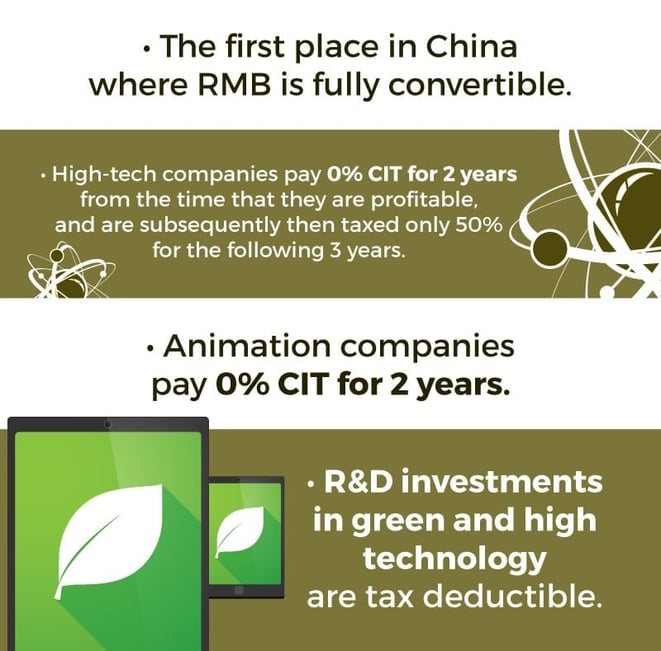
  • Ultra low corporate income tax (CIT) of 15% until December 2020 (even Hong Kong’s is 16.5%, and Mainland China is generally 25%!)
  • CIT Tax breaks for certain industries where tax exemption lasts for 2 years from their first profitable year, and is subsequently charged at 50% (of the standard 25% CIT rate) for the next 3 years
  • ‘Green’ companies rewarded with CIT tax breaks
  • VC SMEs eligible for CIT tax breaks
  • Businesses may account for 30% of their income from none-preferential business activities, meaning that companies have more flexibility in how they can trade
  • Foreign high-end talent, skilled foreign workers, may be eligible for individual income tax reductions by subsidy if the income tax equals 15% or more of their total taxable income
  • Reformed tax declaration, making it easier and faster for companies to handle their taxes in China
  • Close proximity to Hong Kong and the main cities of the PRD
  • Can get loans from Hong Kong banks in CNY, but with Hong Kong loan rates
  • Billions of CNY in government grants for preferred industries
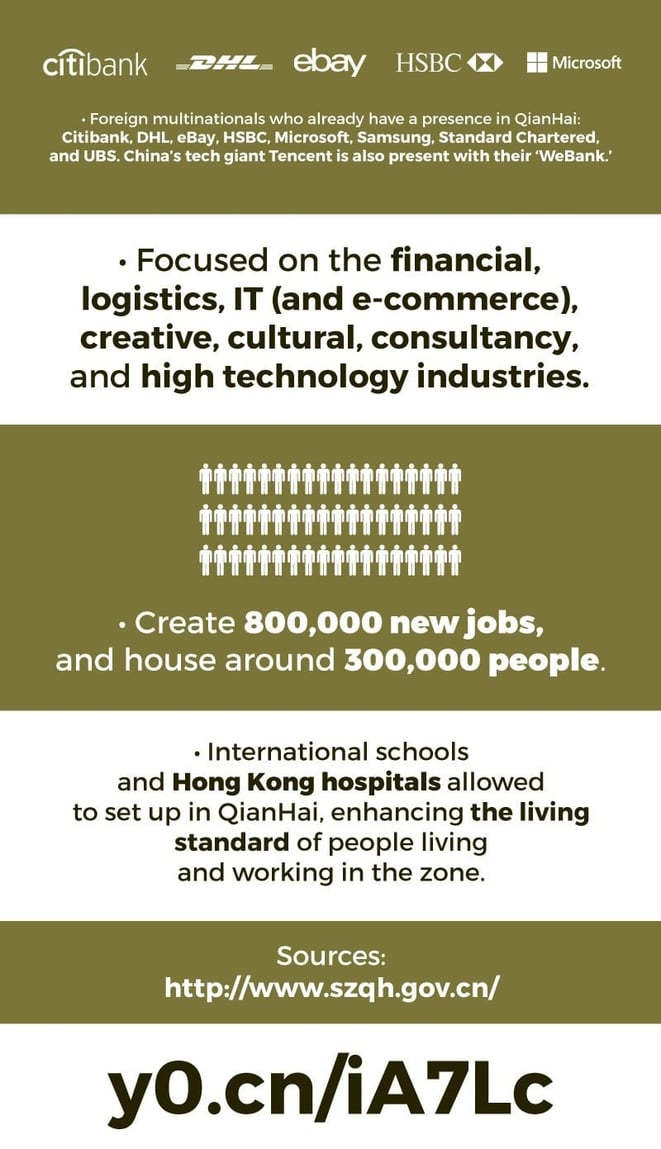
  • Easy access to Hong Kong and overseas banks, many of whom choose Qianhai as their local HQ
  • Hong Kong CPAs may provide their services within the zone as partners of local accounting firms, as may various other registered Hong Kong professionals
  • Hong Kong education providers may set up international standard schools within the zone
  • Hong Kong medical service providers may set up international standard healthcare service providers, such as clinics, within the zone
  • Hong Kong and Macau telecoms providers may set up a joint venture with Chinese firms in order to offer international class telecoms services for the zone
  • World class logistics, be it the custom built port, or the numerous local international airports
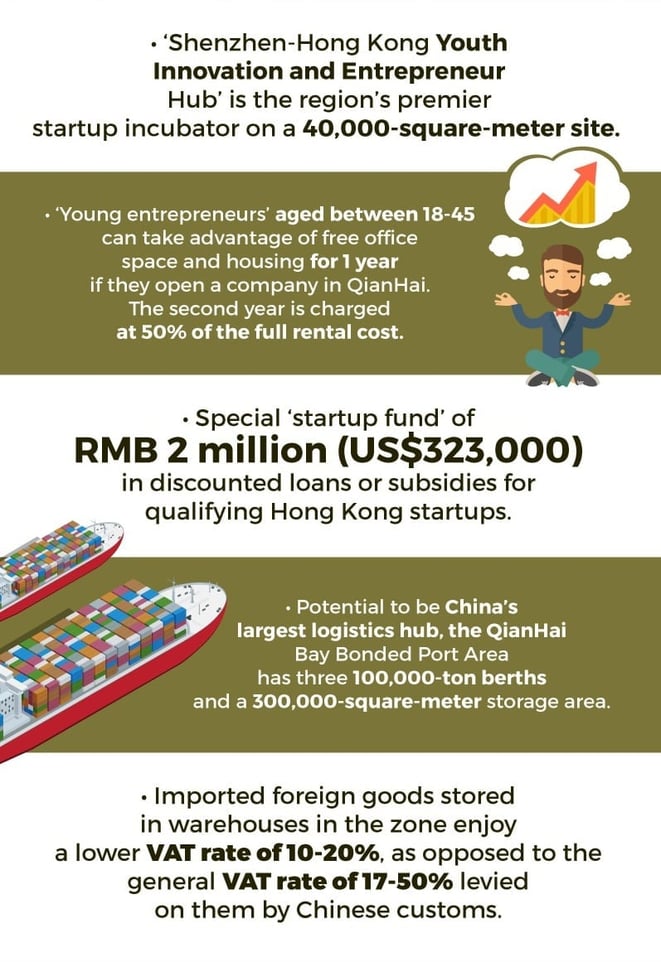
  • Youth entrepreneur innovation hub offering subsidised company start up costs, research, networking with Hong Kong peers, and venture capital opportunities for younger entrepreneurs

How To Set Up A Company In QianHai?
Setting up a Shenzhen Qianhai WFOE requires an investment of 5 Million RMB paid into the capital account, however, this can be spread out over a 5 to 10 year period. You can forego this initial investment if you use an existing Hong Kong registered company to set up your WFOE there
Setting up a company, say a WFOE, is mainly the same as elsewhere in Shenzhen. The difference is that QianHai have some particularly beneficial rules surrounding new business registry.

For instance, you and foreign staff can expect to be taxed at the lower CIT rate of around just 15% - that's less than Hong Kong!

There are also a number of tax breaks and subsidies that the Chinese government grant to new businesses that are in QianHai's preferred niches. For instance, you may be granted free or discounted rent for a number of years, or perhaps you'd be made tax exempt for a period of time to allow you to get well set up.

Shenzhen Qianhai company registration procedures

Step1: Let clients fill out the application form (sign the agreement);

Step2: Confirm the company name, business scope, registered capital and company shares;

Step3: Check the required documents for the clients;

Step4: Pay the services;

Step5: Prepare for the statutory documents for the investors to sign personally;

Step6: Forward documents to related government departments;

Step7: Keep clients informed of processing.

Step8: Finish processing in 15-35 working days;

Step9: Collect the documents and items and settle the balance if any.

Documents Needed To Open Your WFOE

WFOE application form and resolution by Foreign investor’s chairman, signed and stamped

List of directors’ names

Letter of authorisation (4X - This letter is authorisation for the WFOE to be set up by the
foreign investor)

Passport copies of investor, and management of China company

Feasibility study (a study in Chinese that includes the first year business plan and budget, as well as the company seal)

Copies of the business license of the foreign investor company (2X stamped)

Copies of articles of incorporation of foreign investor company (2X stamped)

2X Certificate of Status (original)(U.S. and Canada) or a notarized copy of the Corporate Register for the investor or similar document (original)(Civil Law jurisdictions)

CV of China legal representative (investor) and 6 passport photos

Investor company’s business activity report (Includes business description, brochures, images, and contact information such as website)

An original copy of lease agreement for your business premises in China (2X stamped),

certificates of real estate ownership (2X stamped), and landlord’s ID (2X stamped)

Bank reference letter from investing company’s bank, and bank statement showing 6 month’s balance - demonstrates the good standing and financial stability of the investor (2X Originals and Chinese translation)

Approval paper for corporate formation (Copy)

Notice of enterprise’s name confirmation appraised by the Industry & Commerce Administrative
Bureau (We will help to apply for this, and can assist in the choice of Chinese company name)

2 passport photos of the investor

Proof of investor capital (Usually 100,000 CNY, but this depends on WFOE type)

Corporate certificate of approval receipt (Copy)

we are ready to help you set up your Qianhai company quickly and easily!


Email: tomlee@tommyconsulting.com, Skype: tomleeli
WhatSapp/Wechat/Cell Phone: +86 18926401128


Shenzhen High-Tech Industry make Shenzhen Ideal For Foreign Tech Startups To Register Business Set Up Company In ShenZhen China


Shenzhen, situated just across the border from Hong Kong, is a beautiful coastal garden city in South China. Shenzhen which is the China's first special economic zone established via the patronage of the late Chinese leader Deng Xiaoping is a pioneering and innovative city. It is in the vanguard of China's reforms and opening up to the rest of the world. In its short history of 30 years, Shenzhen has developed from a small fishing village into a modern city with a gross domestic product (GDP) per capita which gives it premier ranking in China.

Shenzhen has risen to become the predominant epicenter of high-tech design and manufacturing in the world. Variously called the “world’s factory,” “the new Silicon Valley,” and the “maker’s dream city,” Shenzhen has a complete ecosystem that contains everything needed for all stages of electronics production all in one place. This has turned the city into a staging ground for large high-tech companies, rising startups, and independent innovators from all over the world looking to get their stuff made as efficiently as possible. Tech giants like Huawei, ZTE , and Tencent all got their starts here, and many more companies seem to be on the way up.

Shenzhen is the place where China's first forays into Reform and Opening — the experiment that sparked China’s particular brand of capitalism — was first deployed. Hardly 35 years ago the place was nothing but a string villages and rice paddies, with 30,000 peasants peaking across the border at an economically rollicking Hong Kong. Now, it is a 12 million person megalopolis that can rival its more established neighbor in almost every way. No city in history has ever grown so large so quickly.

It is said that 90 percent of the world’s electronics are made in Shenzhen. With tens of thousands of factories, 5,000 product integrators, and thousands of design houses, this city has become a one-stop-shop for anything consisting of circuits, chips, LEDs, and touchscreens. Shenzhen is also home to 20% of China’s P.h.Ds, has the country’s highest rate of business owners, and has produced more billionaires than anywhere else in China. In 2014, The Economist declared Shenzhan to be the best place in the world for a hardware innovator to be.
 

The big break for Shenzhen’s electronics industry came with the global popularity of the cellphone. In 2003, Nokia and Motorola were kings. They were producing a product that was almost universally taken to be premium, and their feature phones were selling in the $600 to $800 range. Then Shenzhen took over. Being able to design, produce, and ship their phones around the world vastly cheaper, Shenzhen’s manufacturers undercut the incumbents’ hold on the market with phones that sold for under $100. This made cellphones accessible to a larger swath of people, opened new markets, and ignited the fire of demand for this device that is still spreading today

Strong R&D capability and a complete industrial chain have made high-tech industries Shenzhen's most important pillar.

OUTPUT VALUE

The total output value of high-tech products made in Shenzhen reached 1.7 trillion yuan in 2015, up 11.16% from the previous year.

INPUT IN R&D

In 2015, expenditure of R&D of Shenzhen accounted for 4.05% of its GDP.

R&D POWER

In 2015, the PCT applications amounted to 13,300, comprising 46.9% of the nation's total and stayed at the top of China for several consecutive years. There are 5,524 recognized State-level high-tech enterprises in Shenzhen. The 4G technology, genetic sequencing analysis, metamaterial technology, new energy automobile and 3D display technology are among the leading technologies in the world.

HIGH-TECH INDUSTRIAL PARK

Construction of the Shenzhen High-Tech Industrial Park, known as SHIP, started in September 1996, with a planned area of 11.5 square kilometers. In 2015, there were 985 high-tech companies in the park and 444 companies' annual output value was over 100 million yuan. There were 84 listed companies.

VIRTUAL UNIVERSITY PARK

Shenzhen Virtual University Park was built in 1999. The park's major functions are to train and introduce first-class professionals, integrate industrial and research resources, establish key research labs and doctoral workshops, and promote cooperation between Hong Kong and Shenzhen research centers. So far, it has cultivated more than 240,000 professionals, and fostered 967 start-up companies and 240 research centers. It has eight peacock teams.

HI-TECH FAIR

Cosponsored by the Ministry of Commerce, Ministry of Science and Technology, Ministry of Industry and Information Technology, National Development and Reform Commission, Ministry of Education, Ministry of Human Resources and Social Security, Ministry of Agriculture, State Intellectual Property Office, Chinese Academy of Sciences, Chinese Academy of Engineering and Shenzhen Municipal Government, the China Hi-Tech Fair (CHTF) began in 1999 and has been held each year since. The 18th CHTF will be held in November 2016.

BGI-SHENZHEN

BGI-Shenzhen, established in 2007, is engaged in scientific research of public interest. BGI-Shenzhen has achieved breakthroughs in the large-scale discovery of gene resources, in the sequencing of complicated genomes of higher forms of life, and in the research of inherited diseases. BGI-Shenzhen topped the industrial organizations by collaboration score.

SHENZHEN INSTITUTE OF ADVANCED TECHNOLOGY OF CAS

The Shenzhen Institute of Advanced Technology of CAS was established in 2006 by the Chinese Academy of Sciences (CAS), Shenzhen Municipal Government and The Chinese University of Hong Kong. With a talent pool of around 2,000 scientists, the institute focuses on fields including robotics, healthcare and medicine, new energies and new materials, cloud computing and the Internet of Things. It incubated over 300 companies and five of them will be listed on the National Equities Exchange and Quotations System or ChiNext.

KUANG-CHI INSTITUTE OF ADVANCED TECHNOLOGY

The Kuang-Chi Institute of Advanced Technology is a research institute sponsored in 2010 by industries, government and venture capitalists. Kuang-Chi Institute attracts distinguished scientists from different countries and territories and features collaborative cross-disciplinary research on metamaterials. In 2015, its patent applications reached 3,000 and the patents in metamaterial research accounted for 85% of the total applications in this field.

NATIONAL SUPERCOMPUTING CENTER

The National Supercomputing Center in Shenzhen (Shenzhen Cloud Computing Center) is the city's largest scientific infrastructure facility. The Dawn 6000 supercomputer system can perform 1.27 quadrillion calculations per second, certified in 2010 as the second-fastest system in the world. The center was put into use in November 2011, processing massive data for scientific research, technological and engineering projects as well as serving as a cloud computing center for the whole society.

SHENZHEN-HONG KONG INNOVATION CIRCLE

The establishment of the Shenzhen-Hong Kong Innovation Circle fosters technological collaboration between Shenzhen and Hong Kong to create a global innovation center across the region. Since Shenzhen and Hong Kong signed a plan supporting the Shenzhen-Hong Kong Innovation Circle in 2007.

HIGH-TECH TALENT POOL

By the end of 2015, Shenzhen was home to 1.35 million professional technicians. Of those technicians, 60,000 had studied abroad. The Peacock Plan, aiming to attract top talent from overseas, helped 588 professionals settle in the city in 2015 and helped 1,364 talents in total. In 2015, there were 2.85 million skilled talents in Shenzhen, among them 690,000 were high-skilled talents.


Shenzhen High-Tech Industry make Shenzhen Ideal For Foreign Tech Startups To Register Business  Set Up Company In ShenZhen China


Shenzhen, fulfilling its role as China's 'Silicon Valley,' is now making it easier for foreign startups to incorporate here. What used to be an extremely tortuous and complex process, is now becoming a little more streamlined, although still far more difficult than opening a company in the West.
Tech startups should absolutely consider opening a Shenzhen WFOE (Wholly Foreign Owned Enterprise), as this offers complete control over what your company does, with whom, and when. It also protects your IP, which of course is very important for technical and internet companies where theft is that much easier.

To facilitate people who want to invest and set up company in Shenzhen, here is an introduction of Types of business presence in China:

Before starting up a business in China, you have to know what are the options. Foreign Investors generally establish a business presence in China in one of five modes: Wholly Foreign Owned Enterprise (WFOE); Representative Office; Foreign Invested Partnership Enterprises (FIPE); Joint Venture and Hong Kong Holding Company.

Wholly Foreign Owned Enterprise (WFOE) is a Limited liability company wholly owned by the foreign investor. WFOE requires registered capital and it's liability of equity , can generate income, pay tax in China and it's profit could be repatriate back to investor's home country. Any enterprise in China which is 100 percent owned by a foreign company or companies can be called as WFOE. No. minimum registered capital is required for WFOEs with scope of business of consulting, Trading, retailing, information technology etc. in China. There are minimum registered capital still required for some industries for instance: Banking, Forwarding etc Since China still maintains foreign currency control policy, it's still advisable to choose registered capital within RMB 100,000 ~ RMB 500,000 as the minimum registered capital. Companies can now determine how much capital will be required to maintain their operations and must simply ensure that they meet those targets within a period of 10 years.

Representative Office (RO) is a Liaison Office of it's parent company. It requires no registered capital. It's activities would be: product or service promotion, market research of it's parent company's business, Quality Control liaison office etc in China. RO generally is prohibited to generate any revenue nor generating contracts with local businesses in China.

Joint Venture (JV) is a Limited liability company formed between Chinese investor and Foreign investor. The parties agree to create a entity by both contributing equity, and they then share in the revenues, expenses, and control of the enterprise. JV usually been used by foreign investor to engage the so called restricted in areas such like: Education, Mining, Hospital etc.

Since March 1, 2010, Measures of Establishment of Foreign Invested Partnership Enterprises (FIPE) in China is taking effect. The regulation, which take effect since March 1, 2010, are known as the Administrative Measures for the Establishment of Partnership Enterprise in China by Foreign Enterprises or Individuals. There's no required minimum registered capital for a Foreign Invested Partnership Enterprise (FIPE) in Shanghai, Beijing, Shenzhen, Hangzhou and rest cities of China


Hong Kong Company usually been used as a Special Purpose vehicle (SPV) to invest Mainland China. Hong Kong is one of the quickest locations to Incorporate a business. Although a HK company is not a legal entity in Mainland China (MainlandChina and Hong Kong, See Wiki 1 country, 2 systems), lots foreign investors, especially investors from Europe and North America still chose to setting up a Hong Kong company as SPV to invest China.

After China's entry to WTO, most industries in China welcome foreign investment, WFOE setting up in China becomes the first option of foreign investment's entity structures instead of Rep. Office setting up in China At the mean time, for tax purpose, effective licensing system etc more and more investors use Hong Kong as the holding company to invest China mainland, using this offshore company to hold their operations in China.

Business set-up in Shenzhen is a big project by itself, which requires financial and time commitments, business management knowledge and China expertise. Identifying a competent agent to manage the complex process will be a cost and time effective way to avoid potential pitfalls

Since 2006, Tommy China Business Consulting has been focusing on consulting services for our clients to register company in ShenZhen. We offer a range of company formation services including helping you to set up:

-Wholly Foreign Owned Enterprises (WFOE )
-Joint Ventures (Equity/Co-operative)
-Foreign Invested Partnership Enterprises (FIPE)


Email:  tomlee@tommyconsulting.com,  Skype: tomleeli  
WhatSapp/Wechat/Cell Phone: +86 18926401128